Walmart vs Amazon Price & Shipping Showdown
Amazon just passed Walmart in annual revenue for the first time in 2026, hitting $716.9 billion versus Walmart’s $713.2 billion. But revenue doesn’t mean better prices for you. The real question isn’t who’s winning the market, it’s who wins for your shopping needs.
Amazon dominates tech and electronics, while Walmart crushes it on groceries and everyday essentials. Your best deal depends on what you’re buying and which membership makes sense for your household.
Key Highlights
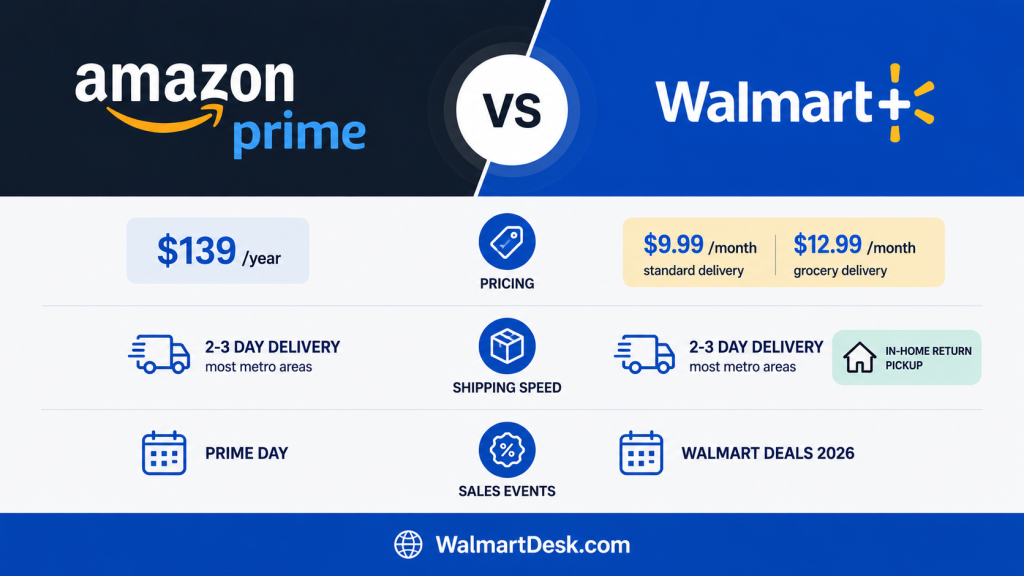
- Amazon Prime costs $139/year, while Walmart+ starts at $9.99/month for standard delivery or $12.99/month for grocery delivery
- Shipping speed is now nearly identical, both offer 2-3 day delivery in most metro areas, but Walmart’s in-home return pickup gives it an edge for large items
- Amazon Prime Day and Walmart Deals 2026 overlapped for several days, creating direct price competition across electronics, appliances, and home goods
Price Comparisons Across Categories
Let me tell you the actual prices from summer 2026 sales. These are real dollar amounts you’d pay at checkout.
Electronics & Tech Deals
Amazon wins on tech during Prime Day. A 65-inch 4K Samsung TV sold for $399 on Amazon versus $379 at Walmart, a small Walmart edge, but Amazon’s inventory lasted longer through the sale.
A MacBook Air M3 hit $899 on Amazon versus $949 at Walmart, a $50 Amazon win. AirPods Pro 2 matched at $169 on both.
Amazon’s fulfillment network and tech partnerships give it deeper inventory and exclusive Prime Day deals that Walmart can’t always match.
Groceries & Household Essentials
Walmart dominates groceries. A gallon of 2% milk costs $3.29 at Walmart versus $3.89 on Amazon Fresh.
A box of Cheerios runs $4.49 at Walmart versus $5.19 on Amazon. A 36-pack of Bounty paper towels costs $24.99 at Walmart versus $29.99 on Amazon Fresh.
Walmart’s local store network and bulk-buying focus give it a real edge on perishables and staples. Amazon Fresh has limited city coverage and higher costs that get passed on to shoppers.
Home Goods & Appliances
This category is a toss-up depending on timing. During Walmart Deals 2026, a KitchenAid stand mixer dropped to $279 versus Amazon’s $299. But a Dyson V15 vacuum hit $599 on Amazon Prime Day versus $649 at Walmart.
Both retailers adjust prices during sales, so the winner shifts depending on which sale period you’re shopping.
Shipping Speed & Delivery Guarantees
The shipping speed gap between Amazon and Walmart has nearly closed in 2026.
- Amazon Prime guarantees 2-day delivery on Prime-eligible items in metro areas.
- Walmart+ offers 2-3 business day delivery on most items, with some arriving in 2 days depending on your location.
In rural areas, Walmart’s advantage shows. Local store pickup and fulfillment from nearby Supercenters often beat Amazon’s regional warehouse distances, and users increasingly report Walmart matching or beating Amazon’s delivery speed, especially for non-tech items.
Note
The bigger difference is returns. Walmart’s in-home return pickup means Walmart schedules FedEx to pick up large items right from your home. Amazon requires you to print a label and drop items off at UPS or an Amazon locker, which is a hassle for furniture or appliances.
Membership ROI
- Amazon Prime costs $139 a year, or $14.99 a month if billed monthly.
- Walmart+ is a bit more complex $9.99/month for basic delivery, $12.99/month for grocery delivery, or $98/year for the bundle.
To find your breakeven point, calculate your actual monthly savings.
Membership also includes perks beyond discounts. Prime adds video streaming, music, pharmacy discounts, and faster checkout.
Walmart+ adds grocery delivery, fuel discounts, and scan-and-go checkout. If these matter to you, your breakeven happens faster.
Calculate Your Breakeven Month
- A light shopper spending $50 a month would take 28 months to break even on Prime and over 30 months on Walmart+, so neither is worth it at that level
- An average household spending $150 a month breaks even on Prime in about 9 months if they save $15 a month, and on Walmart+ in about 10 months if they save $10 a month
- A heavy shopper spending $300 a month breaks even in about 4-5 months on Prime and 5-6 months on Walmart+
Seller Quality & Counterfeit Risk
Both platforms rely heavily on third-party sellers, and both have counterfeit problems. The difference is in how they vet sellers and fulfill orders.
Amazon’s FBA uses automated scanning and random human audits of inventory. Sellers pay $39.99 a month, which creates more accountability but higher counterfeit risk in categories like electronics and luxury goods due to sheer seller volume.
Walmart’s WFS has stricter brand partnership requirements and lower seller volume. The $0 monthly fee attracts more sellers, but Walmart’s approval process is more selective, so counterfeit risk tends to be lower, though niche categories may have less variety.
★ For high-value items like electronics or luxury goods, buy directly from Amazon or Walmart fulfilled inventory rather than third-party sellers, and check for ratings of 4.8+ stars with 100+ reviews.
Walmart’s stricter seller vetting reduces counterfeit risk compared to Amazon’s larger marketplace.
Return Policies & Post-Purchase Experience
Amazon offers 30-day returns on most items, with 60-90 days for some categories. You print a return label and drop items off at UPS or an Amazon locker. Refunds process within 5-10 business days after Amazon receives the item, with no restocking fees on most items.

Walmart offers 90-day returns on most items, giving you more time. The bigger advantage is in-home pickup, FedEx comes to your home, so you skip the trip to a drop-off location. Some opened electronics and appliances have a 15% restocking fee, but basic returns are free. Refunds typically process within 5 business days.
✦ For large items like furniture or appliances, Walmart wins.
✦ For small items like books or electronics under $50, both are equally convenient.
Walmart’s longer window also gives you more time to decide if you’re unsure about a purchase.
Prime Day 2026 vs Walmart Deals 2026
Amazon Prime Day 2026 and Walmart Deals 2026 overlapped in June, creating direct competition.
Amazon’s inventory ran deeper on tech and Amazon devices, while Walmart focused on groceries, home goods, and everyday essentials.
Neither sale was objectively better, they complemented each other. Smart shoppers checked both based on what they actually needed.
Amazon shows countdown timers and inventory levels in the app, making it easier to track deals as they end. Walmart’s notifications are just as fast, but inventory updates lag a bit. Both sell out limited-quantity items within minutes, so speed matters if you’re hunting something specific.
Mobile App & User Experience
✦ Amazon’s app is faster at checkout, with 1-Click purchasing letting you buy in seconds.
✦ Walmart’s app is a bit slower to check out, but shows delivery windows and pickup options right away.
Both apps send fast deal notifications, though Walmart occasionally lags on updating inventory. Amazon has a slight speed edge for flash deals, but Walmart is catching up.
Note
Walmart’s app is better for checking local inventory and pickup options. Amazon’s is better for browsing tech specs and comparing seller ratings.
My Suggestions
I’d calculate my household’s monthly spend by category and see which one takes up the biggest chunk. Then I’d join whichever membership matches that strength first, Amazon Prime for tech, Walmart+ for groceries and essentials.
After 3-6 months, I’d check if the membership paid for itself. If it did, I’d consider adding the second one too, as long as the breakeven stays under 12 months.
I’d also test both platforms during Prime Day and Walmart Deals, and use their free trials before committing to anything.
Amazon’s bigger revenue doesn’t mean better value for you. Walmart is closing the shipping gap and winning on returns. Pick the retailer that fits your actual spending, not the one with bigger numbers.