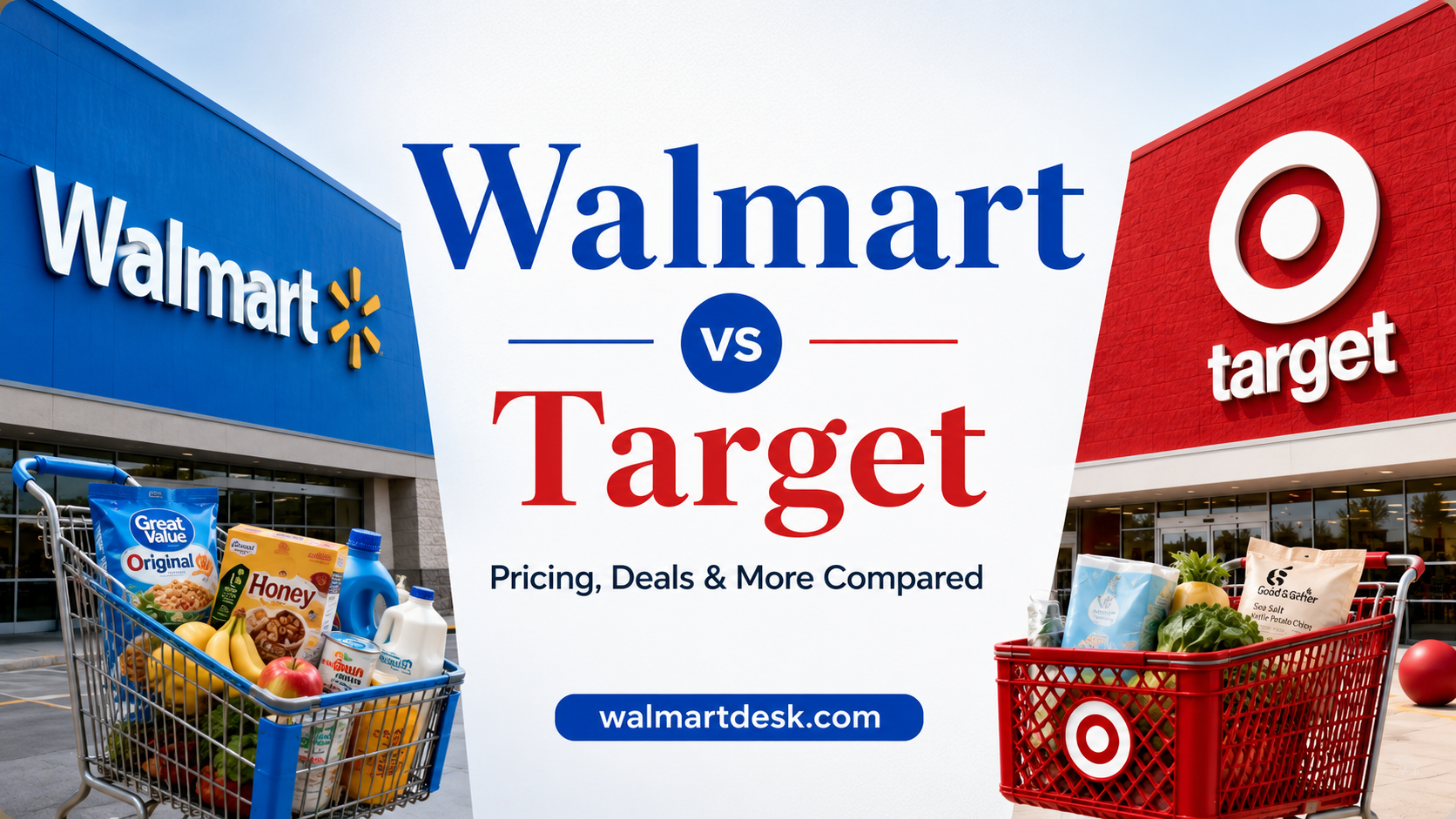
Walmart vs Target – Which Is Actually Cheaper in 2026?
The answer is not as simple as most people think. It depends on your membership status, the product category, and where you are shopping in 2026.
After analyzing pricing across both retailers, here is what I found.
Target Circle members with a RedCard often match or beat Walmart prices. Quality differences also affect the true cost per use in ways that raw price comparisons tend to miss.
Takeaways
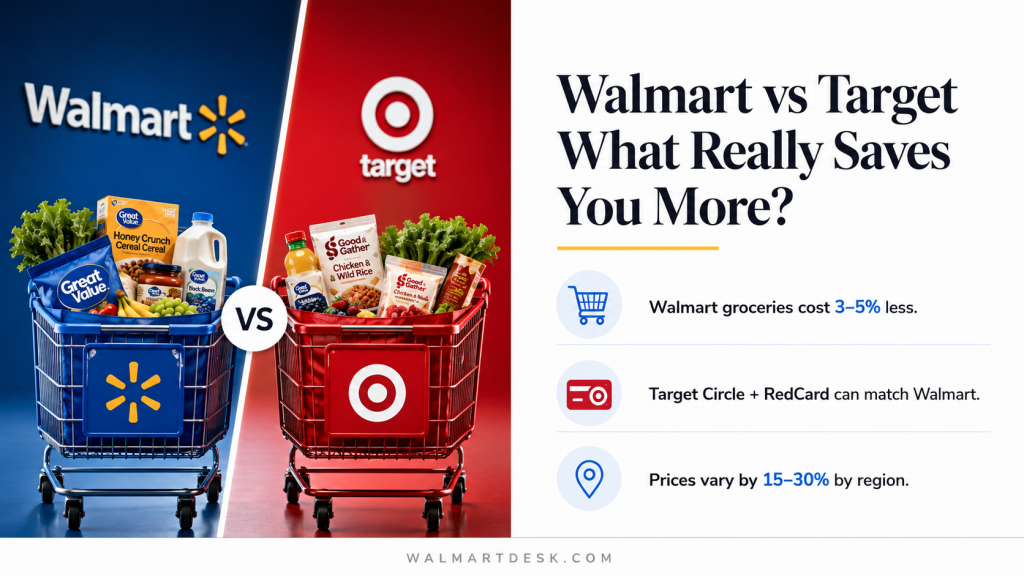
- Walmart wins on groceries by 3 to 5% but Target Circle members with a RedCard often close the gap or match the price entirely
- Great Value costs less upfront but Good and Gather sometimes offers better quality, which affects the true cost per use over time
- Regional pricing varies by 15 to 30% and membership benefits differ by household, so there is no single winner that works for everyone
Walmart vs Target
Here’s where each retailer wins across major categories in July 2026:
| Walmart | Target | |
|---|---|---|
| Groceries | Eggs $2.49, Milk $3.19 Canned beans $0.59 | Eggs: $2.99 Milk $3.79 Canned beans $0.79 |
| Clothing | Basic t-shirt $8.97 Jeans $19.97 | Basic t-shirt $9.99 Jeans $24.99 |
| Electronics | Samsung TV 55″ $299.99 | Samsung TV 55″ $279.99 |
| Home Goods | Bedding, kitchen 5-8% cheaper | Bedding, kitchen in a better design |
| Membership Impact | Walmart+ $98/year | Target Circle 5% RedCard discount |
Prices can change across different locations. A gallon of milk costs $2.99 in rural Texas but $4.19 in urban California.
Groceries & Staples
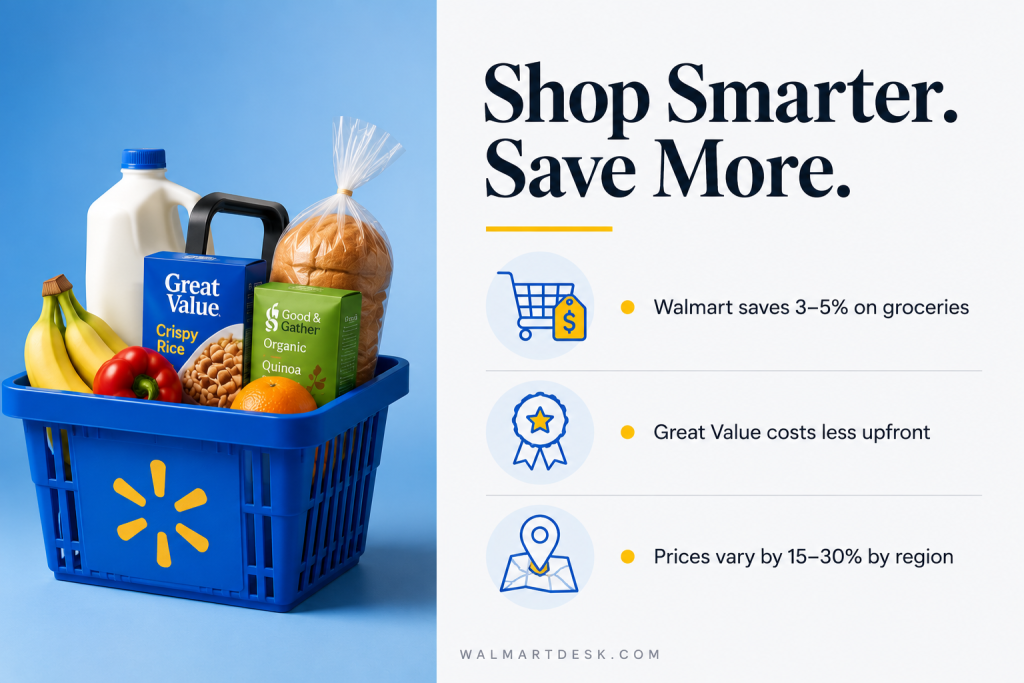
Walmart has cheaper prices on most everyday grocery items, usually about 3-5% less. This is why people say, “Walmart is cheaper,” and it’s true.
Walmart is bigger, has better deals with suppliers, and pays less in labor costs. All of this means lower prices for you.
These are some commonly used items with side by side price comparison.
Items
- Eggs (dozen)
- 2% Milk (gallon)
- Canned black beans
- Pasta (1 lb)
- Cereal (18 oz)
Prices
- $2.49 at Walmart vs. $2.99 at Target
- $3.19 vs. $3.79
- $0.59 vs. $0.79
- $0.99 vs. $1.19
- $3.49 vs. $4.29
But if you have a Target RedCard, you get 5% off groceries. That closes the price gap to just 1-2%.
★ If a family spends $2,000 a year on groceries, that’s only about $100 more at Target. That’s not a huge amount, especially if you like Target’s stores or products better.
Great Value vs Good & Gather Quality
Great Value is Walmart’s store brand. It’s made for people who want the lowest price, using cheaper ingredients that often come from overseas.
Good & Gather is Target’s store brand. It costs a bit more but focuses on products made in the U.S. and being more eco-friendly.
The quality difference is real, but it depends on the product. Great Value pasta costs 15% less, but it breaks apart more easily when you cook it. Once you count the pasta you waste, you’re really only saving about 8%.
Great Value canned beans taste basically the same as Good & Gather. But Great Value olive oil is thinner and doesn’t taste as good.
Important
So, the simple rule is that for basic stuff like rice, beans, and canned food, go with Great Value. For things where taste and quality really matter, like pasta, olive oil, and peanut butter, Good & Gather is worth the extra money.
Clothing & Apparel
Target doesn’t always have the lowest prices, but it gives you more for your money. Their store brands, like Cat & Jack, All in Motion, and Universal Thread, fit better, are made better, and last longer than Walmart’s clothes.
A basic white t-shirt costs $8.97 at Walmart and $9.99 at Target. That’s only a $1 difference. But Target’s shirt keeps its color better, the seams don’t fall apart after five washes, and the sizes fit more the same every time.
If you wash it every week for a year, Target’s shirt lasts longer. That means you actually pay less per wear in the end.
Return Timeline
- Target also lets you return stuff within 30 days
- Walmart only gives you 15 days
This is worth about $15-20 a year if you like to try things at home before deciding to keep them. And if you use a RedCard, you get 5% off clothes at Target, which makes the prices even closer to Walmart’s.
Membership ROI
Walmart+ costs $98 a year in 2026 and gives you some good perks.
✦ You get about $0.10 off every gallon of gas
✦ Free delivery on grocery orders over $35
✦ Free shipping on Walmart.com.
If your family fills up on gas 25 times a year, that’s about $250 in savings just from gas. That alone makes the membership worth it.
Target’s Circle program has some good perks too, and it’s free.
✦ You get 5% off everything when you use a RedCard
✦ No yearly fee, unlike Walmart+
If your family spends $2,500 a year at Target, you’d save about $125 with a RedCard, and you don’t even have to pay for a membership.
If you live in a rural area or drive a lot, Walmart+ is the better choice. If you live in a city or shop at Target a lot anyway, Target Circle with a RedCard is the smarter pick.
Online vs In-Store Pricing Gaps
Prices can be pretty different depending on if you shop online or in the store.
A Samsung 55″ TV costs $299.99 in a Walmart store but $279.99 online at Target. An Instant Pot costs $79.99 in a Walmart store but only $74.99 online.
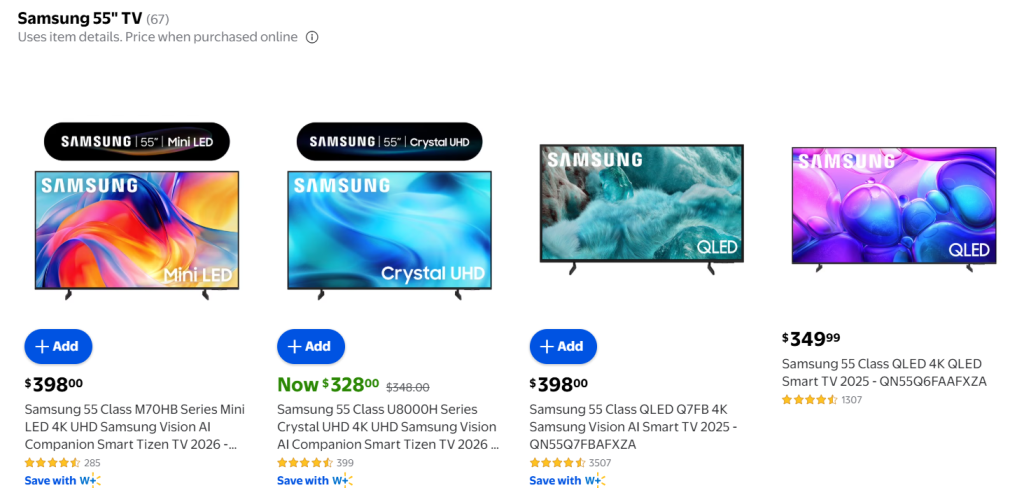
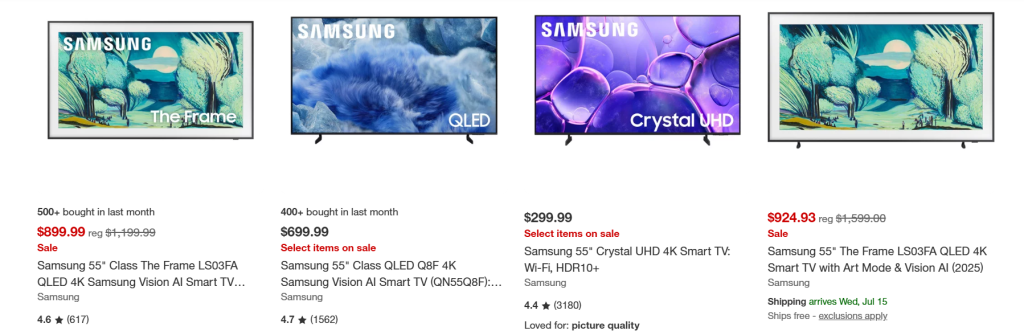
These price differences happen because of shipping costs, changing prices based on demand, and how much stock is in different areas.
I was looking for this 55-inch TV on both websites, and found the price to be almost the same. So, you have to constantly look for the desired product on website and in-store.
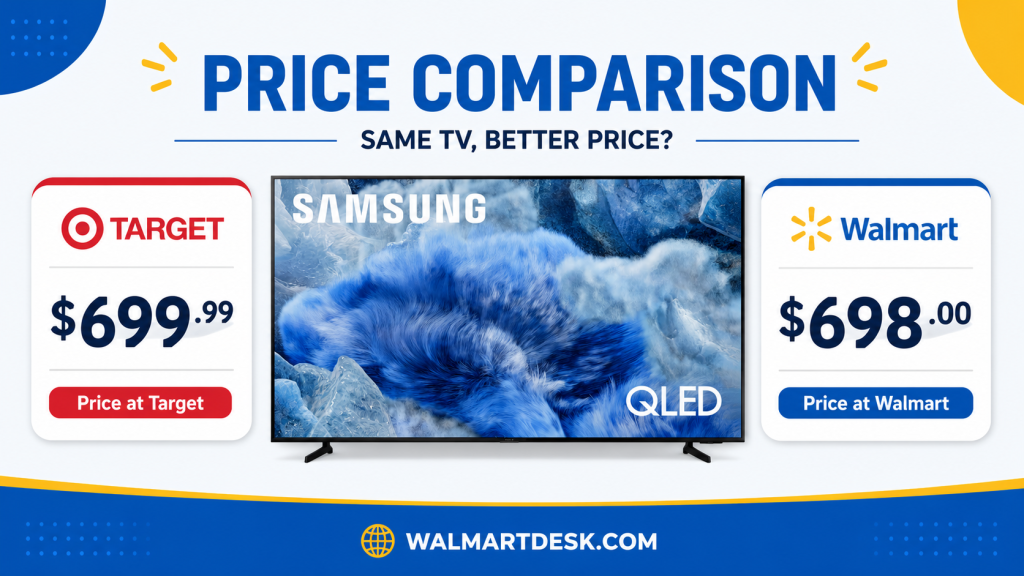
I have seen that they sometimes put huge discounts on in-store.
For people like me, online works fine as i am too lazy to go to the store, so i prefer to browse for offers online and sometimes, if i am lucky, i get the deal what i was looking for.
- Walmart offers free shipping if you spend $50 (or $35 if you have Walmart+).
- Target does the same thing, $50 for regular shoppers, or $35 if you’re a Circle member.
If you shop online a lot, that lower shipping limit can save you $30-50 a year.
★ Always check prices both online and in-store before you buy something. Electronics and seasonal stuff are usually cheaper online. Groceries and everyday basics are usually cheaper in-store.
Regional Pricing & Seasonal Sales
There’s no one clear winner between Walmart and Target for the whole country.
Prices swing by 15-30% depending on where you live, local competition, and cost of living. For example, eggs might cost $1.99 at a Walmart in rural Texas but $3.49 at one in urban California.
The time of year matters too.
- Target has great deals on clothes and school supplies during back-to-school season (July-August).
- Walmart usually wins on holiday groceries (November-December).
Black Friday shakes things up even more, changing which store has the better deal depending on what you’re buying.
Note
Check prices at your own local stores before you shop and try to buy big stuff during the season when each store has its best deals.
Hidden Costs & True Savings
The price on the shelf isn’t the whole story. Things like return policies, checkout speed, and app usability can also add value or cost.
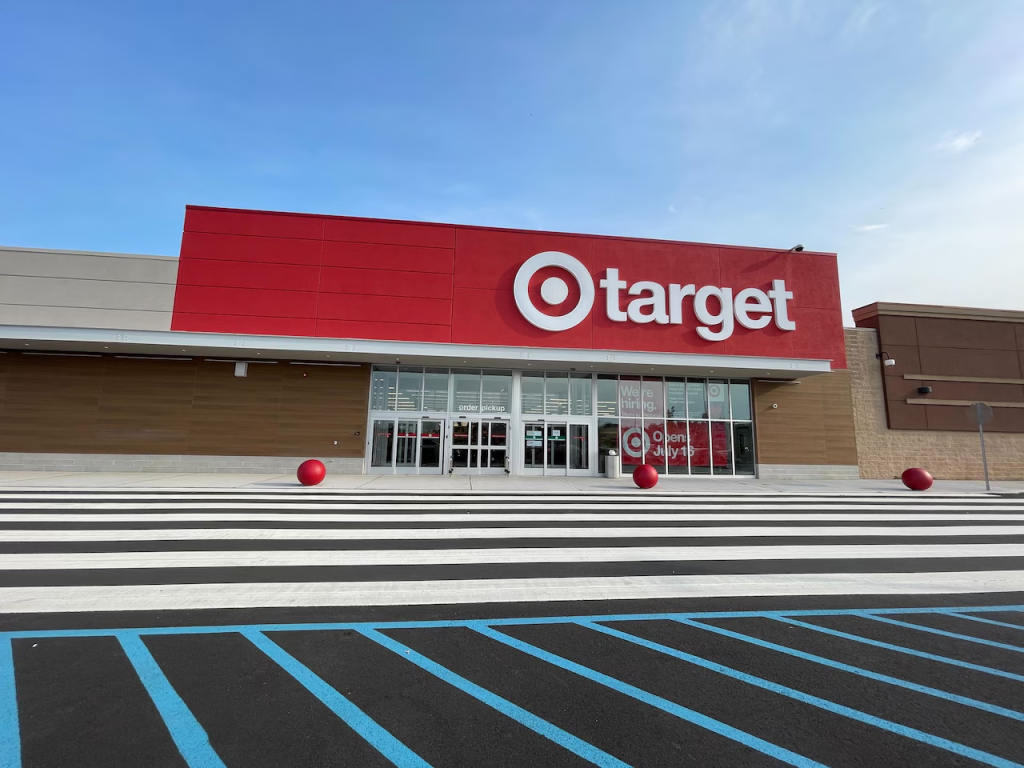
Target gives you 30 days to return stuff, while Walmart only gives you 15. This matters a lot for clothes.
At Target, you can wash something once or twice before deciding to keep it. Walmart doesn’t give you that much time. For careful shoppers, this adds about $15-20 a year in value.
Walmart’s checkout lines take about 10 minutes on average, while Target’s only take about 5. Target’s app is also faster and easier to use, saving even more time.
For most families in 2026, shopping at Target with a Circle account and RedCard costs about the same or less than shopping at Walmart without a membership, once you count the discounts, return policy, and convenience.
Better Retailer between Walmart or Target
The answer depends on your shopping habits:
- For price-only shoppers, Walmart for groceries and household items; Target for clothing with RedCard.
- For fuel buyers, Walmart+ ROI is positive if you fill up 20+ times/year.
- For quality-conscious shoppers, Target’s durability and design justify the small premium on most categories.
- For online shoppers, check both channels, prices diverge significantly on electronics and seasonal items.
- For regional shoppers, verify local pricing; don’t assume national trends apply to your area.