How Much Is a Propane Tank at Walmart? Refill vs Exchange
Walmart exchanges propane tanks. It does not refill them. A 20 lb exchange runs about $20 to $27 as of July 2026, and the tank you carry out holds 15 lbs of propane, not 20.
That last part catches almost everyone. Getting a propane tank at Walmart is fast and cheap, but you are paying a flat fee for a partial fill, and the gap between what you pay and what you get is bigger than most people realize.
Below is what the exchange actually costs, how much gas is really in the tank, and when it makes sense to drive somewhere else and get your own tank filled instead. I have also included current pricing context for the rest of the store.
Walmart Propane Tank Exchange Price
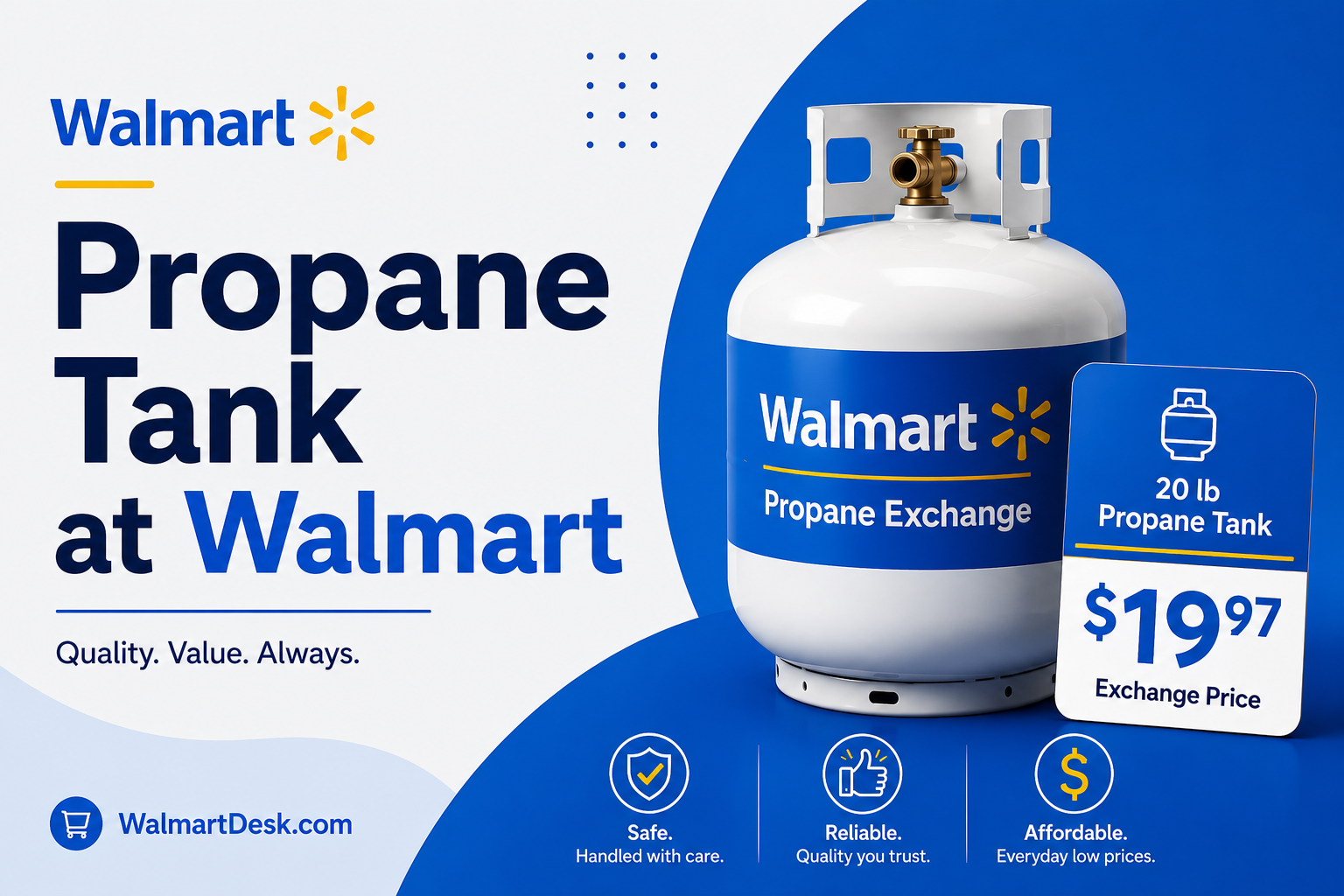
A standard 20 lb propane tank exchange at Walmart costs $20 to $27 as of July 2026, depending on your store and which vendor supplies it. Some stores post it as low as $19.92.
Walmart does not set that price from a national list. Propane is a commodity, the exchange is run by an outside vendor, and the shelf price moves with wholesale rates and your region. The number at a Walmart in rural Ohio and one in Los Angeles will not match.
Most Walmart stores stock Blue Rhino. Some carry AmeriGas. The price and the fill amount are close enough that it rarely matters which one your store has.
Call the store before you drive over. Propane pricing is one of the few things Walmart associates can quote accurately over the phone in about ten seconds.
Walmart Does Not Refill Propane Tanks
No Walmart store refills propane tanks. Stores do not have pumps, scales, or licensed staff to do it. Anyone who tells you a Walmart associate weighed and filled their tank at the service desk is describing a different retailer.
What Walmart runs is an exchange. You bring an empty tank, you hand it over, and you take a pre-filled one from a locked cage. The cage sits outside near the entrance or in the garden center, because propane cylinders are not allowed inside the building.
This distinction matters for money. An exchange is a flat fee. A refill is priced by the gallon, and you only pay for what goes in.
How Much Propane Is in an Exchange Tank
A 20 lb exchange tank contains 15 lbs of propane. Not 20. Blue Rhino states this directly and prints it on the packaging.
Propane tanks are filled to a maximum of 80 percent of capacity as a safety measure, which is why Blue Rhino puts 15 lbs into a 20 lb tank.
The 80 percent rule is real and it applies everywhere. Propane expands when it warms up, and the empty space at the top of the tank gives it somewhere to go. A tank filled to the brim on a cool morning will vent through the safety valve by afternoon.
Here is the part that annoys me. A refill station will also stop at 80 percent, which on a 20 lb tank means roughly 20 lbs of propane by the tank’s rated capacity. The exchange gives you 15. You are paying a premium for less gas, and the tank looks identical.
Exchange vs Refill Cost Comparison
A refill runs about $3 to $4 per gallon. A 20 lb tank holds roughly 4.7 gallons, so a full refill lands around $15 to $20. Compare that against a $22 exchange and the per pound cost is not close.
| Factor | Walmart exchange | Refill elsewhere |
|---|---|---|
| Propane you get | 15 lbs | Up to 20 lbs |
| Typical cost | $20 to $27 | $15 to $20 |
| Cost per pound | About $1.47 | About $0.85 |
| Time in store | 5 minutes | 15 to 30 minutes |
| Must own the tank | No | Yes |
| Tank condition matters | No | Yes |
The exchange costs roughly 70 percent more per pound of propane. On a single tank that is about seven dollars, which is nothing. Across a grilling season where you burn through six tanks, it is over forty.
If you grill a few times a summer, the exchange cage is fine and the math does not matter. If you grill most weekends, or you heat a workshop, or you run an RV, the exchange is quietly one of the worst per unit deals in the store and I would stop using it.
Where to Refill a Propane Tank Instead
Refill stations are less common than exchange cages, but they are not hard to find. These chains fill tanks at many locations.
- U-Haul, which fills tanks at most of its dealer locations and posts per gallon rates
- Ace Hardware, where availability varies store to store
- Tractor Supply, reliable in rural areas
- Ferrellgas and AmeriGas branch offices, which also handle recertification
- Local propane dealers and some gas stations, usually the cheapest option per gallon
Costco fills tanks at select warehouses with a gas station, but it is members only and coverage is thin. Home Depot and Lowe’s mostly run exchange cages just like Walmart, so switching to them changes nothing about the math above.
If you travel with propane, this is worth planning around. Anyone using an RV parked overnight at Walmart can grab an exchange tank in the morning, but a refill station on the route out will cost less.
How the Walmart Propane Exchange Works
The whole thing takes about five minutes. Carry your empty tank to the cage outside, then go inside and pay at any register. An associate walks back out with you, unlocks the cage, takes your empty, and hands you a full tank.
Do not bring the tank into the store. It is a fire code issue and staff will turn you around at the door.
You do not need a receipt, and the tank you hand over does not have to be a Blue Rhino. Any standard 20 lb grill cylinder is accepted. You also do not need the tank to be in good shape, which is the exchange program’s one genuine advantage over refilling.
Which Tanks Walmart Will Accept
Walmart accepts standard 20 lb steel grill cylinders from any brand. Rusted, dented, or expired tanks are usually fine, because the vendor recertifies or retires them off site.
What gets rejected is anything outside that spec. Odd sizes, aluminum cylinders, tanks with damaged valve collars, and tanks that still have propane in them. Burn the gas off before you go.
Certification only matters if you plan to refill. A propane cylinder is certified for 12 years from the manufacture date stamped on its collar, then needs requalification before a filling station will touch it again. After the first requalification, a visual inspection buys another five years. AmeriGas and most propane dealers will check the stamp for you.
An expired tank is the one case where the exchange clearly wins. Recertification costs time and money. Swapping the tank at Walmart makes the problem disappear for the price of a fill.
Walmart Propane Availability by Store
Not every Walmart carries propane. Supercenters almost always do. Neighborhood Markets often do not, because they lack the outdoor space and the local permits.
Some cities restrict outdoor propane storage entirely, which is why a store in a dense urban area may have no cage at all while the one twenty minutes out has two. Check the store page on Walmart.com or use the Walmart store locator before you load a tank into your trunk.
Walmart’s price match policy does not cover propane exchange, so a cheaper tank at a competitor down the road is not something the register will honor.
Propane Tank Safety and Transport
Transport the tank upright and secured. A cylinder rolling around a trunk can shear its valve, and the relief valve is designed to vent liquid propane if the tank tips.
Do not leave it in a hot car. Propane expands as it warms, the safety valve opens, and you lose gas you just paid for. On a 90 degree day, an hour of errands is enough.
Store the tank outdoors, upright, in a shaded and ventilated spot. Never in a basement, and never in an attached garage. Check the valve and the connection for cracks before you hook it up, and if you smell propane at any point, disconnect and move the tank away from the house.
When to Exchange and When to Refill
Exchange at Walmart when you need propane in the next ten minutes, when your tank is expired or beaten up, when you do not own a tank at all, or when you burn through fewer than three tanks a year.
Refill somewhere else when you own a tank in good condition, you use propane regularly, and there is a filling station within a reasonable drive. The savings only compound if you are going through gas.
One habit worth building either way. Buy a second tank and keep it full. Running out mid cookout is what pushes people into paying $27 for 15 lbs of propane on a Sunday afternoon, and that is exactly the moment the exchange cage is designed for.